
Views: 0 Author: Site Editor Publish Time: 2026-09-04 Origin: Site


Modern automation, security, and safety systems rely heavily on precise proximity and motion detection to function correctly. A single false positive or missed detection can halt production lines, compromise facility security, or cause severe safety hazards on the factory floor. Selecting the right detection technology is a critical engineering challenge that directly impacts operational uptime. Deploying the wrong sensor type in environments with varying light, dust, or thermal dynamics leads to system failures and heavy maintenance overhead.
An active infrared sensor provides a deterministic, beam-based solution to these detection challenges. Unlike passive alternatives that rely on environmental heat signatures, active sensors emit their own light to establish a controlled baseline. This guide breaks down the mechanics of active infrared technology. We will compare its performance against passive alternatives and provide a technical evaluation framework for system integrators and electrical engineers to ensure reliable field deployments.
Mechanism of Action: Active infrared sensors operate by emitting their own IR radiation and measuring either the reflection off an object or the physical interruption of the beam.
Active vs. Passive: Unlike passive variants that solely detect emitted thermal radiation (body heat) changing over space and time, active sensors establish a controlled, constant baseline, making them ideal for precise proximity and perimeter detection.
Implementation Realities: While highly reliable for line-of-sight applications, performance is heavily influenced by surface reflectivity, ambient light interference, and environmental particulates.
Evaluation Focus: Procurement and engineering decisions must prioritize beam angle, detection range, spectrum wavelength, physical installation footprint, and integration protocols over baseline unit cost.
The core hardware consists of two primary components that work in tandem. The IR LED acts as the emitter, generating a specific wavelength of infrared light driven by a regulated current source. A photodiode or phototransistor serves as the receiver. This receiver detects the emitted light when it bounces back from a target or travels across a physical gap. The physical arrangement of these two components dictates how the sensor functions in the field. In industrial designs, the emitter circuit often includes a driver chip to pulse the LED, while the receiver circuit features a transimpedance amplifier to convert the tiny photocurrent into a usable voltage signal for the logic controller.
Engineers must understand that the alignment between the emitter die and the receiver lens determines the optical gain. Misalignment at the microscopic level during manufacturing reduces the effective range. High-quality units use precision-molded acrylic or glass lenses to collimate the emitted light into a tight beam, maximizing the energy delivered to the target or the opposing receiver.
An active infrared sensor operates primarily in the Near-Infrared (NIR) spectrum. This typically ranges from 850nm to 940nm. This specific wavelength remains completely invisible to the human eye, preventing visual distraction in operator-facing applications. In contrast, passive systems operate in the Mid-to-Far Infrared (LWIR) thermal spectrum, usually around 8µm to 14µm. Active sensors do not look for heat; they look for their own specific light wavelength.
The choice between 850nm and 940nm depends on the application. The 850nm LEDs offer higher optical output power and better sensitivity with standard silicon photodiodes, but they emit a faint red glow visible in dark environments. The 940nm LEDs are completely invisible, making them preferred for covert security applications, though they suffer a slight drop in receiver sensitivity. Understanding this spectral difference is fundamental when specifying components for discrete installations.
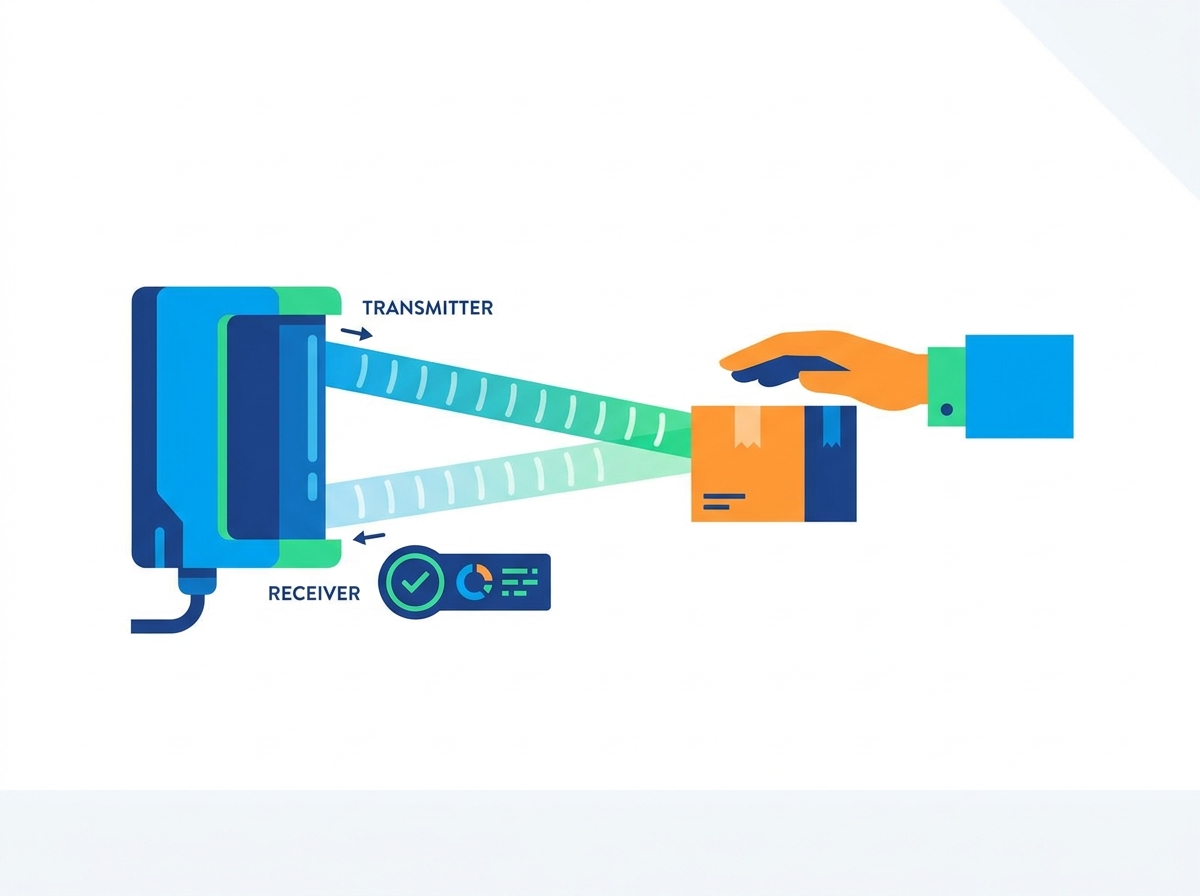
In reflection mode, the emitter and receiver are housed together in a single unit. The emitter sends out a continuous or pulsed beam of light. When an object enters this path, the light bounces off the target surface. The returning light hits the receiver. The system calculates presence based on a predefined signal threshold. If the returning light is strong enough, the sensor triggers an output.
This mode is highly dependent on the target's surface characteristics. A white, flat piece of paper will reflect significantly more IR light than a black, textured rubber tire. To combat this, advanced reflection sensors utilize triangulation. Instead of just measuring light intensity, they measure the angle of the returning light on a linear imager array. This allows the sensor to determine the exact distance to the object, ignoring background reflections and variations in target color.
Interruption mode requires the emitter and receiver to face each other across a physical distance. The emitter sends a continuous infrared beam directly into the receiver. When an object breaks this invisible line, the receiver loses the signal. The sensor immediately triggers an output. This setup is commonly used in safety curtains and perimeter security systems.
Because the light travels directly from the emitter to the receiver without relying on target reflection, break-beam systems offer the highest reliability and longest range. Industrial light curtains stack dozens of these emitter-receiver pairs in a single housing to create a dense web of beams. If a machine operator's hand breaks even one beam, the control system instantly halts the hazardous machinery. The deterministic nature of this mode makes it the standard for life-safety applications.
Industrial environments are full of ambient infrared sources. Sunlight, halogen lamps, and welding arcs emit heavy IR noise. To prevent false triggers, industrial-grade sensors modulate the emitted IR pulse. They flash the light at specific, high frequencies, typically between 10 kHz and 100 kHz. The receiver is tuned with a bandpass filter to only recognize that exact frequency.
This modulation allows the sensor to ignore intense background light and focus solely on its own beam. If a constant DC light source, like the sun, hits the receiver, the internal circuitry blocks the DC component and only amplifies the AC modulated signal. Without this feature, outdoor or factory-floor deployments would be impossible due to constant saturation of the photodiode.
Active sensors emit their own IR signals to create a detection zone. Passive infrared sensors do not emit anything. Instead, PIR sensors use pyroelectric materials to detect spatial and temporal changes in ambient thermal radiation. They look for heat signatures moving across their segmented field of view. Active sensors detect physical presence, while passive sensors detect moving heat.
A PIR sensor requires a temperature differential between the moving object and the background. If a person walks through a room that is exactly body temperature, the PIR sensor may fail to detect them. An active sensor does not care about temperature. It will detect a block of ice or a heated steel billet with equal reliability, provided the object breaks the beam or reflects the light.
Active sensors excel in highly controlled, deterministic applications. They are necessary for detecting non-heat-emitting objects like cardboard boxes, glass bottles, or metal parts on a conveyor. They provide precise distance gating, allowing engineers to set exact detection boundaries. High-speed manufacturing lines rely on active sensors because they react instantly to beam interruptions, often with response times under one millisecond.
If you need exact boundary control, active technology is the correct choice. You can pinpoint a detection zone down to a few millimeters. This precision is required for tasks like robotic arm positioning, label application verification, and counting small components dropping down a chute.
Passive sensors are more appropriate for general area monitoring. They dominate room occupancy detection for HVAC and lighting control. Battery-operated residential security systems use PIR because it draws very little power, often running for years on a single coin cell. Wide-area human detection is easier with PIR since it covers a broad field of view without needing a reflector or opposing receiver.
PIR sensors use Fresnel lenses to divide their viewing area into alternating active and inactive zones. As a warm body crosses these zones, the sensor generates an alternating signal. This makes them excellent for detecting lateral movement across a room, but poor at detecting a person walking directly toward the sensor.
Power consumption is a major differentiator. Active sensors require continuous power to drive the LED emitter. Passive sensors draw minimal current, simply waiting for a heat change. However, active sensors provide much higher deterministic accuracy for specific zones. You trade higher power consumption for exact, reliable line-of-sight detection.
| Feature | Active Infrared | Passive Infrared (PIR) |
Emission | Emits NIR light (850-940nm) | None (Receives LWIR 8-14µm) |
Detection Target | Physical objects (any temp) | Moving heat signatures |
Response Time | Sub-millisecond | Hundreds of milliseconds |
Power Draw | High (Continuous LED drive) | Ultra-low (Microamps) |
Best Application | Conveyors, safety curtains | Lighting control, room alarms |
Manufacturing facilities deploy active IR for conveyor belt object counting and web tension control. Machine safety guarding relies heavily on light curtains. The key feature here is a high-speed response time. The direct outcome is reduced production bottlenecks and immediate machine shutdown during safety breaches. Precision keeps the assembly line moving efficiently without damaging products.
Consider a high-speed bottling plant. Clear glass bottles move down the line at hundreds of units per minute. Standard photoelectric sensors struggle with clear objects. Engineers deploy specialized active IR sensors with polarized filters and low-hysteresis thresholds to reliably detect the leading edge of every glass bottle, ensuring the filling nozzles actuate at the exact right millisecond.
Break-beam sensors are standard for fence-line monitoring. Automated gate operations use them to prevent closing on vehicles. The primary feature is an invisible, continuous beam spanning long distances. The outcome is tamper-proof intrusion detection. Intruders cannot easily bypass a beam they cannot see, ensuring high-security perimeter integrity.
Mount the emitter on a rigid post at the perimeter edge.
Mount the receiver on an opposing post, ensuring direct line-of-sight.
Align the optics using a voltmeter to measure the receiver's signal strength.
Wire the output relay to the main alarm control panel.
Test the beam by walking through it at various speeds to verify trigger response.
You interact with an infrared sensor daily in touchless sanitary fixtures and automatic doors. Robotics use them for basic obstacle avoidance. Engineers must balance form factor, power draw, and reliability in these applications. The sensors must be small enough to hide behind plastic bezels while remaining robust enough for thousands of daily triggers.
In automated guided vehicles (AGVs) used in warehouses, active IR arrays provide short-range collision avoidance. They act as a secondary safety layer beneath the primary LIDAR scanners. If the AGV gets too close to a rack or a worker's boot, the IR proximity sensors detect the reflection and instantly cut power to the drive motors.
Matching sensor specifications to the physical environment is crucial. A narrow beam angle increases the maximum detection range. However, narrow beams require highly precise mechanical alignment. A wide beam angle covers more area and is easier to align. The trade-off is that wide angles sacrifice overall distance and can catch unwanted side reflections from nearby walls or machinery.
When evaluating resolution, consider the smallest object you need to detect. A sensor with a large optical footprint might miss a thin wire passing through its beam. Conversely, a sensor with a pinpoint laser-like IR beam can detect tiny components but will false-trigger on airborne dust particles. Select the beam profile that matches your target size.
Physical mounting dictates sensor selection. High-reliability break-beam active sensors require dual-sided wiring. You must run power and signal cables to both sides of the gap. If the application cannot support dual-sided wiring, you must evaluate single-sided retroreflective or proximity sensors. Always check conduit availability before specifying a dual-sided system.
Retroreflective sensors offer a middle ground. They house the emitter and receiver in one unit but bounce the beam off a specialized prismatic reflector mounted across the gap. This requires wiring on only one side while maintaining much of the reliability of a true break-beam setup. However, shiny objects passing through the beam can sometimes trick the receiver into thinking it sees the reflector.
Operating environments severely impact IR signals. Direct sunlight can saturate receivers if lux immunity is low. Heavy dust, fog, and moisture scatter the infrared beam, reducing range. Industrial applications require IP-rated enclosures like IP67 or IP69K. Outdoor deployments must meet strict NEMA standards to survive water ingress and extreme temperature fluctuations.
| IP Rating | Protection Level | Ideal Environment |
IP65 | Dust tight, water jets | Indoor manufacturing, light washdown |
IP67 | Dust tight, temporary immersion | Outdoor gates, heavy machinery |
IP69K | Dust tight, high-pressure steam | Food and beverage processing |
Analyze the electrical requirements of your control system. Determine if you need NPN/PNP, relay, or analog voltage outputs. Modern scalable architectures often utilize IO-Link for advanced diagnostics. The sensor must interface seamlessly with existing PLCs or microcontrollers. Ensure the power supply can handle the continuous current draw of multiple active emitters.
NPN (sinking) and PNP (sourcing) outputs are the standard in industrial automation. You must match the sensor's output type to the input card of your PLC. Wiring a PNP sensor to an NPN input will result in a failure to register signals. Additionally, consider sensors with built-in short-circuit and reverse-polarity protection to prevent damage during installation.
Dense deployments risk multiple active infrared sensors interfering with one another. If receiver A sees emitter B's light, false triggers occur. Mitigation tactics include alternating modulation frequencies between adjacent sensors. Physical shielding and channel multiplexing also prevent crosstalk. Proper spatial planning is mandatory when installing multiple sensors in close proximity.
When mounting sensors facing each other in a row, alternate the emitter and receiver positions. Instead of having all emitters on the left and all receivers on the right, swap every other pair. This drastically reduces the chance of a receiver picking up stray light from an adjacent emitter, maintaining the integrity of the detection grid.
Reflection mode suffers from the "dark object" problem. Matte black or highly porous materials absorb IR light rather than reflecting it. This causes missed detections. You can mitigate this by utilizing background suppression technologies. Alternatively, switching to a break-beam setup eliminates reflectivity variables entirely, as the object only needs to block the light.
Background suppression sensors use a position-sensitive detector (PSD) instead of a simple photodiode. They calculate the angle of the returning light to determine distance. This means a black rubber tire at 10 centimeters will trigger the sensor just as reliably as a white plastic box at 10 centimeters, completely ignoring a shiny metal background at 15 centimeters.
Long-term deployment requires realistic maintenance planning. Routine lens cleaning is necessary in dusty environments. Break-beam systems subject to heavy machinery vibration require frequent physical alignment checks. You must also account for LED degradation over time. Recalibration ensures the signal threshold remains accurate as the emitter slowly loses intensity over years of continuous use.
Implement a preventative maintenance schedule based on the environment. In a cleanroom, sensors may operate for years without intervention. In a sawmill, sawdust accumulation on the lenses will cause signal degradation within days. Use sensors with built-in alarm outputs that notify the PLC when the received signal strength drops below a safe margin, allowing for cleaning before a hard failure occurs.
An active infrared sensor serves as a highly reliable, deterministic tool for proximity and interruption detection. Success depends heavily on controlling environmental and installation variables. To ensure a successful deployment, follow these actionable steps:
Categorize your exact needs by detection type, choosing between presence or motion.
Map out your physical installation constraints to determine if single-sided or dual-sided wiring is feasible.
Analyze the material properties and color of the target objects to avoid absorption issues.
Assess environmental exposure levels, including ambient light and dust, before requesting vendor quotes.
Conduct a proof-of-concept using evaluation kits in the actual deployment environment before committing to mass procurement.
A: It emits a specific wavelength of infrared light. The sensor then measures either the reflection of that light bouncing off an object or the physical interruption of the continuous beam between an emitter and a receiver.
A: Active sensors emit and receive their own infrared light to detect physical presence. Passive sensors do not emit anything; they only receive thermal radiation to detect temporal and spatial changes in heat signatures.
A: They typically operate in the Near-Infrared (NIR) spectrum, between 850nm and 940nm. This wavelength is invisible to human eyes but highly detectable by standard silicon photodiodes.
A: Yes, but with limits. High-quality sensors use optical filters and high-frequency signal modulation to ignore sunlight. However, extreme direct sunlight can still saturate the receiver in outdoor environments.
A: Transparent materials like glass or clear plastic can cause false reflections or allow the beam to pass through. Dark, matte, or porous materials can absorb the infrared signal, causing missed detections in reflection mode.
A: Detection ranges vary widely. Reflection proximity sensors typically detect objects from a few centimeters up to a few meters. High-power break-beam systems can span hundreds of meters.
A: Common culprits include dust or moisture on the lens, mechanical misalignment from vibration, severe ambient light saturation, or optical crosstalk from adjacent sensors operating on the same frequency.
